

 Battle Study Package: Washita
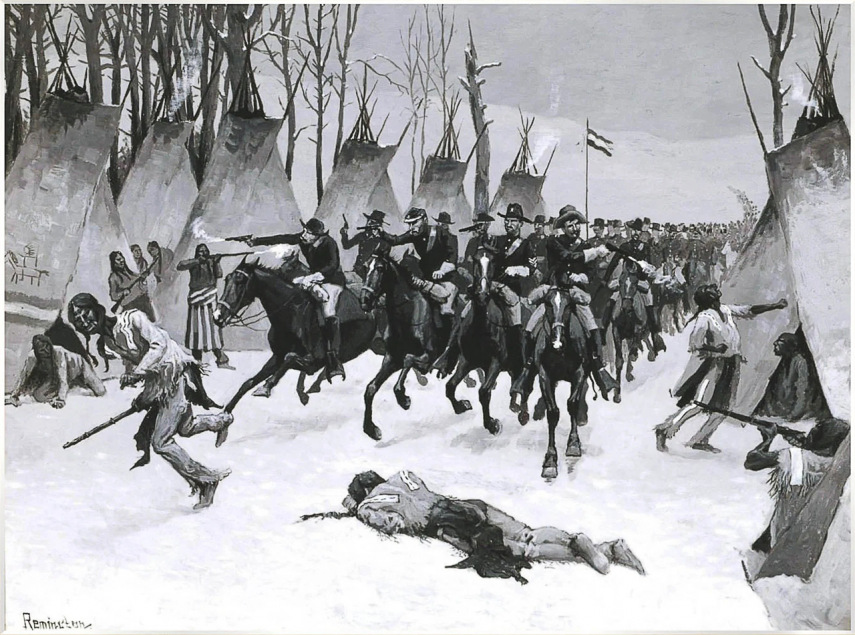
LTC George Custer and the 7th Cavalry launch a surprise attack against Black Kettle’s winter encampment.
HISTORICAL SIGNIFICANCE
The 7th Cavalry attack of the Cheyenne Camp along the Washita River on 27 November 1868 remains one of the most controversial events to occur during the westward expansion of the United States. Historians continue to debate as to whether the incident constitutes a battle or a massacre—with even the number of Cheyenne casualties remaining disputed. Ultimately, the incident along the Washita demonstrated the post-Civil War U.S. military’s ability to conduct a successful campaign against Indian tribes during winter—which would become a trademark for future military operations against the western tribes.
TACTICAL IMPORTANCE
The 7th Cavalry’s assault on Black Kettle’s camp along the Washita River was the culminating engagement of GEN Philip Sheridan’s 1868-1869 campaign against the Cheyenne and Arapahoes. Following a series of Indian raids, murders, and kidnappings throughout his Department of the Missouri, GEN Sheridan endeavored to punish Cheyenne and Arapahoes tribes whom he deemed were guilty of aiding and abetting these outrages—ignoring the loose power structure and tenuous political unity of these tribes and treating each as a single entity.
In many previous battles against the Plains tribes, the Indians demonstrated an impressive prowess in mounted warfare. The lightweight and speed of the mounted Indians enabled them to strike quickly and then easily escape the much slower and heavier U.S. Cavalry while their knowledge of the terrain allowed them to dissipate into the wilderness, which made it almost impossible for the U.S. forces to track the location of their mobile encampments. Realizing the Indians’ advantages in speed and mobility, GEN Sheridan decided to launch a campaign in winter—where the cold weather and snow would greatly impede the mobility of the Indian encampments—allowing his. Reminiscent of his experiences in the American Civil War, GEN Sheridan sought to evoke total war by destroying the Indian’s homes and making all—regardless of combatant status—feel the effects of war. His orders explicitly stated to kill all combatants and to take all women and children as prisoners.
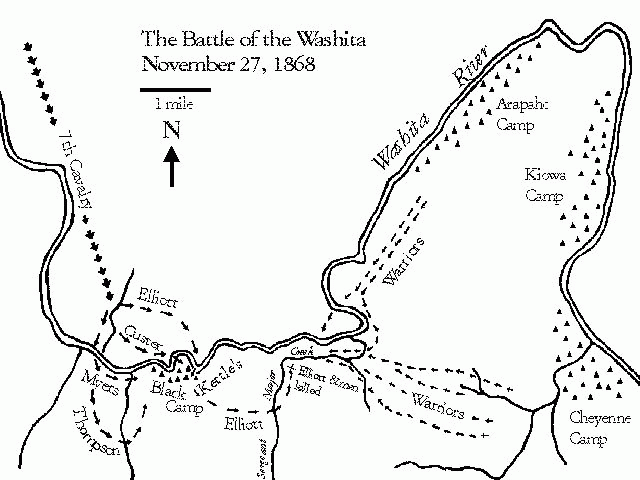
GEN Sheridan planned a three-pronged offensive into the territory held by the Indians: one wing would head from Fort Lyon, CO, another from Fort Bascom, NM, and the final—lead by LTC Custer with his 7th Cavalry—would establish a base of operations and move in from modern-day Oklahoma. LTC Custer and his force of roughly 800 men established a fort named Camp Supply before departing into the Indian-held territory on 23 November. On the 26th, a scouting party located a fresh Indian trail; consequently, Custer ordered his men to lighten their load, bringing only weapons, ammunition, limited food, and fodder, as well as a few ammunition wagons. By midnight, one of LTC Custer’s scouts—a member of the Osage Tribe—detected signs of an Indian encampment, which they soon located near a bend in the Washita River.
LTC Custer’s plan for attacking the Indian encampment was to break down his unit into four separate commands, each attacking the village from different directions: Northeast, Norwest, Southwest, and West. At first light, LTC Custer and his men rode into position and charged to the tune of “Garryowen.” The 7th Cavalry had achieved complete surprise and the situation devolved into chaos. Small groups of Cheyenne warriors formed small pockets of resistance but were overwhelmed. Command and control broke down as LTC Custer’s men fired indiscriminately, killing non-combatants including women and children. Black Kettle and other Cheyanne who tried to escape were summarily gunned down. A portion of LTC Custer’s command, led by Maj Joel Elliott, tried to pursue a group of escaping Indians but were surrounded and killed by warriors who arrived from another Indian camp nearby. Around 1000, Custer noticed additional Indians appearing on the surrounding hills and after interrogating a captured Cheyanne woman learned that the village he attacked was not in isolation—with several over encampment located nearby. However, Custer preoccupied himself with reorganizing his command, gathering up captured loot, herding together the 53 women and children who survived the attack as hostages, shooting down over 600 ponies to prevent them from falling into the hands of the Indians. Fearing that the surrounding Indians would cut him off from his supply train, LTC Custer feigned an advance toward the nearby Indian encampments; this ruse convinced the Indians to return their camps, allowing the 7th Cavalry to reverse course and meet up with their wagon train. The 7th Cavalry returned to Camp Supply on 1 December. Total casualties for the 7th Cavalry were 21 killed and 13 wounded, whereas the Cheyenne suffered between 13-150 killed and 53 captured—many of whom were also wounded.
STRATEGIC IMPACT
Aside from the loss of lives, horses, and materials suffered by the Cheyanne, the incident at the Washita helped to destroy the Plains Indians’ sense of security. The sanctuary that was once afforded to the Plains Indians by the winter months was gone, and now U.S. forces could launch sustained campaigns against them when they were at their weakest. By the end of January 1869, most of the Cheyenne had been brought back under U.S. control. Although this campaign would not be the last of the Plain Wars, the Winter Campaign of 1868-1869 demonstrated the U.S. military’s new prowess in fighting against the Plains Indians.
Map
Podcasts
Books