

 Battle Study Package: Ball’s Bluff
The Debacle on the Potomac.
HISTORICAL SIGNIFICANCE
The Battle of Ball’s Bluff was a failed attempt by Union forces to cross the Potomac River and probe Confederate defenses around Leesburg. The high casualties suffered by Union forces prompted Congress to establish the Joint Committee on the Conduct of the War.
TACTICAL IMPORTANCE
In mid-October of 1861, Gen George McClellan was consolidating the Union Army of the Potomac near Washington D.C. in preparation for an advance on Richmond. After hearing reports that a Confederate brigade under Col Nathan “Shanks” Evans had abandoned Leesburg, VA, Gen McClellan ordered a division commanded by Gen George McCall to advance toward Dranesville, VA, to assess the situation. After having returned to Leesburg earlier and been informed of Gen McCall’s movement, Col Evans left a small scouting force to watch the Potomac and advanced toward Dranesville to check the Union advance, establishing a defensive position near Burnt Bridge on 19 October. On 20 October, Gen McClellan ordered that McCall’s division withdraw (they would eventually complete this by the afternoon of the 21st) while ordering Gen Charles Stone and his division—which was positioned across the Potomac from Leesburg—to make a “slight demonstration” to see how the enemy would react.
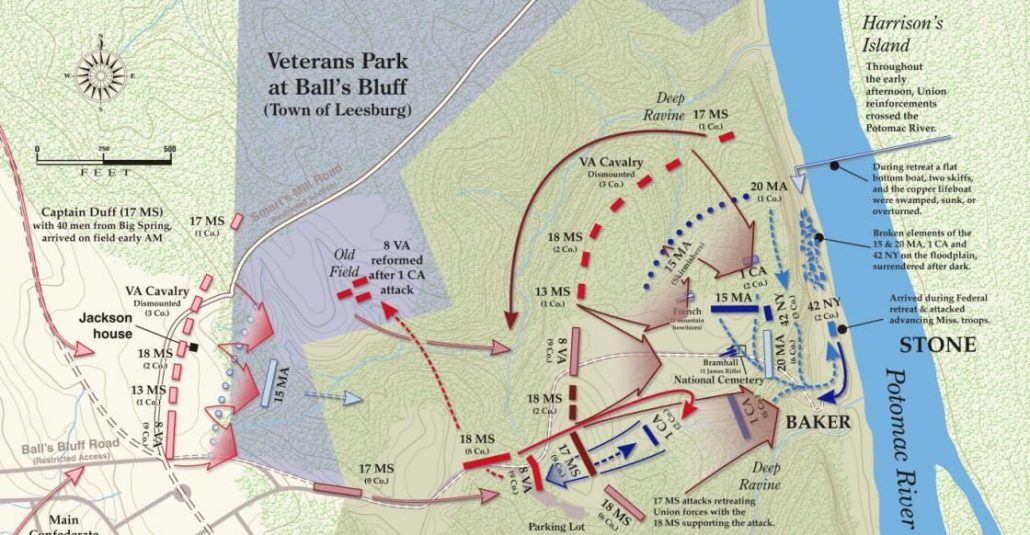
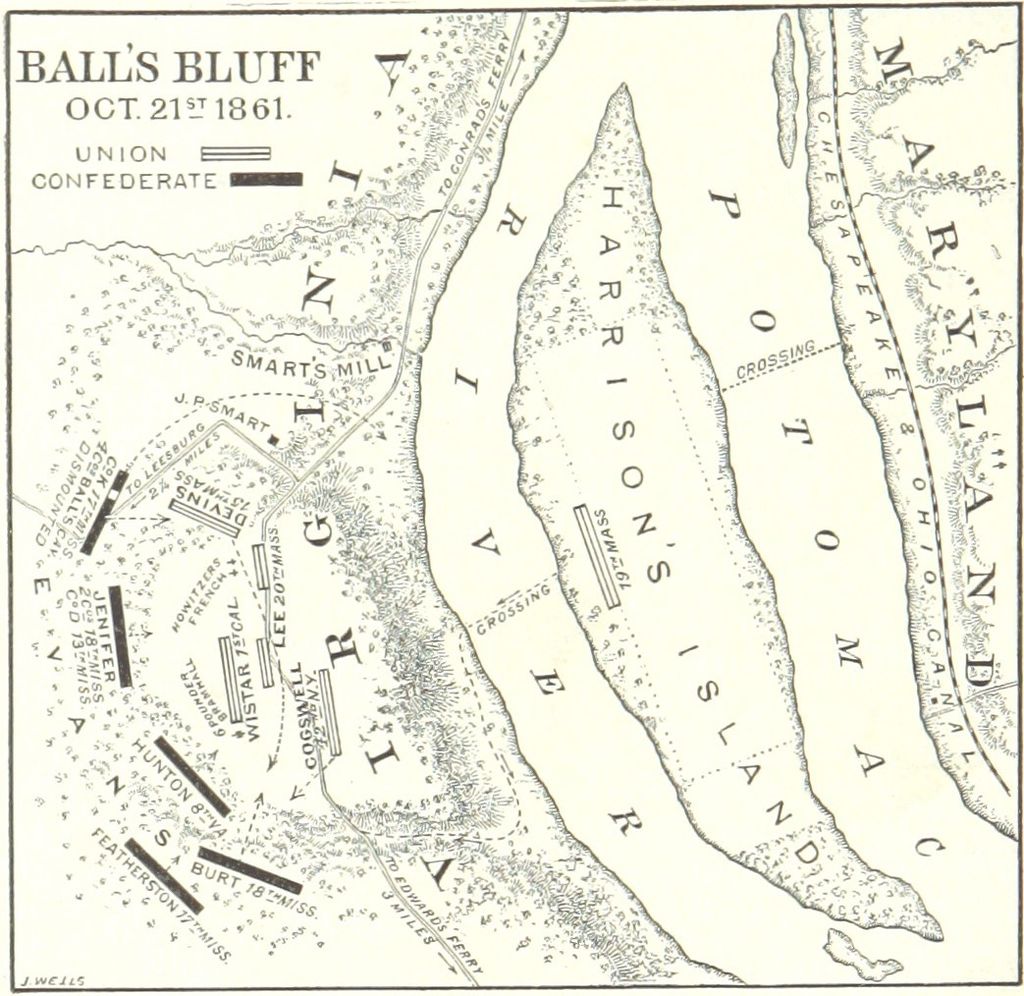
Stone sent a portion of his force to Edwards Ferry where they lobbed a few shells over the river and sent a small unit to cross the river before quickly returning. Later that night, another Union scouting party crossed the river and saw what they believed to be enemy tents nearby. Gen Stone then decided to launch a raiding party on the Confederate “camp,” and on the morning of the 21st, sent 300 men of the 15th MA under the command of Col Charles Devens across the river with only a small number (3-4) of boats available. After realizing that there was no enemy camp, Col Devens updated Gen Stone on the situation who then deployed the remaining men of the 15th MA across the river. Gen Stone sent one of his subordinates, Col Edward Baker (a U.S. Senator) to further assess the situation and to determine if the troops should withdraw or be reinforced. Col Baker, after hearing that a skirmish with Confederate forces had begun, ordered that additional regiments be sent across the river despite the fact there was a severe shortage of transportation.
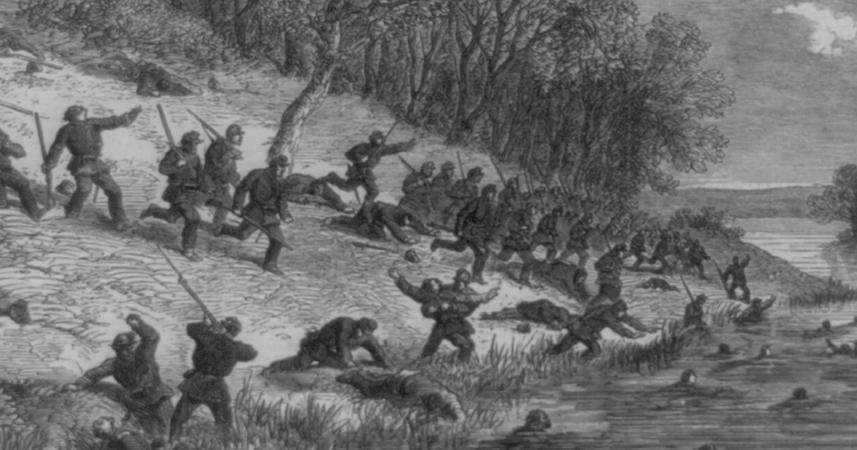
Col Evans realized that the Federal forces near Dranesville were departing and took advantage of the enemy’s inability to effectively ferry troops across the river to concentrate his forces and halt any further Union incursion toward Leesburg. After some intense fighting, Col Baker was killed around 4:30 in the afternoon, which subsequently caused Union command and control to dissipate. By evening, the Federals had withdrawn toward the bluffs overlooking the Potomac River. The darkness caused even further command and control problems, and a final Confederate assault managed to route the Union forces. Many of the Union soldiers were captured and several other unfortunate participants drowned while trying to cross the Potomac. In all, the Union suffered around 1,000 total casualties compared to around 150 Confederate losses.
STRATEGIC IMPACT
The Battle of Ball’s Bluff had little strategic impact and would be remembered as a relatively minor affair in the years to come. However, the combination of a high casualty rate for Federal units involved, the death of a U.S. Senator, and instances of dead soldiers floating down the Potomac by Washington. horrified Congress, thus prompting the creation of the Congressional Joint Committee on the Conduct of the War, which would increase partisan tensions and hamper many generals’ careers throughout the American Civil War.
Maps
Study Guide
Podcast
Books