

 Battle Study Package: Horseshoe Bend
MajGen Andrew Jackson Ends Creek Resistance against American Encroachment.
HISTORICAL SIGNIFICANCE
The Battle of Horseshoe Bend was among the most decisive victories in Gen Andrew Jackson’s military career. In successfully capturing the Creek fortified settlement of Tehopeka, Gen Jackson granted the United States control of over 23 million acres of land—much of which would be used to form the state of Alabama.
TACTICAL IMPORTANCE
During the War of 1812, a schism occurred in the Creek Indian Tribes of Georgia and the Mississippi Territories. The Upper Creek—known as the Red Sticks—were opposed to American expansionism and supported the British, whereas the Lower Creek had adopted many Anglo-American cultural, social, and economic practices and sided with the Americans. This schism erupted into Civil War, with the Americans siding with the Lower Creeks, eventually escalating to direct confrontation at the Battle of Burnt Corn—where Americans failed in an attempt to ambush Red Sticks who were returning from British Pensacola with arms and ammunition. This resulted in an increase in retaliatory strikes of the Upper Creek against American settlements, culminating in the Fort Mims Massacre. Consequently, MajGen Andrew Jackson was ordered to the region to subdue the Upper Creeks.
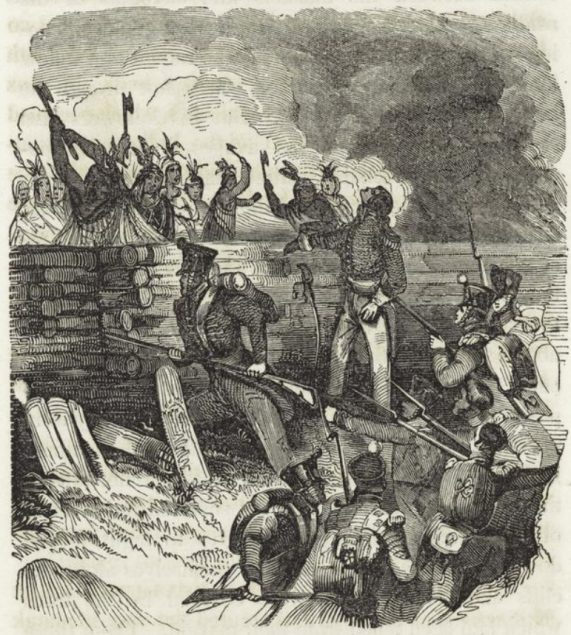
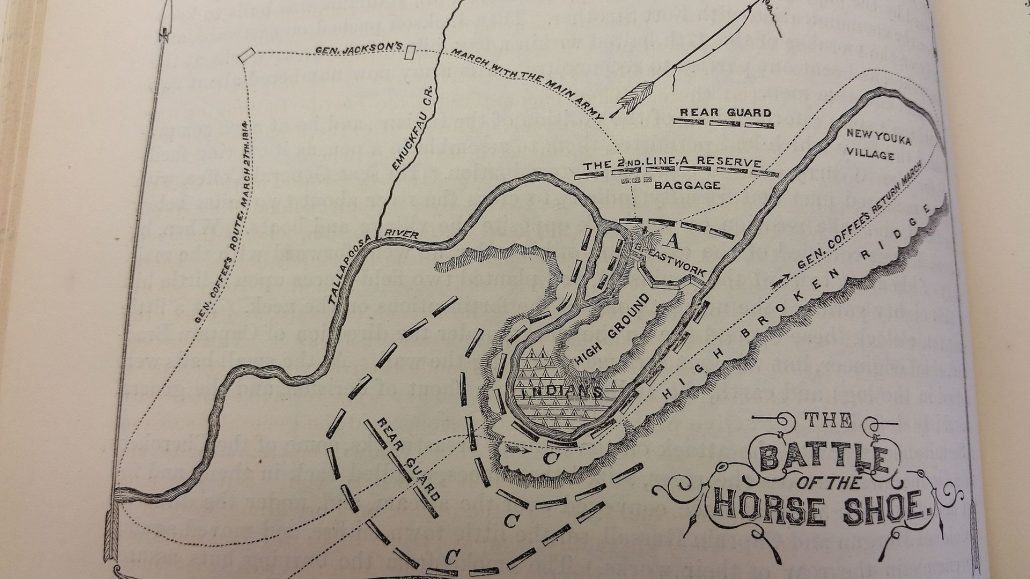
With a combined force of regular troops, militiamen, Cherokees, and Lower Creek warriors, numbering over 3,000 men, MajGen Jackson moved through the Wilderness toward the Upper Creek village of Tehopeka, located in a bend of the Tallapoosa River—known as Horseshoe Bend. The Red Sticks, with an estimated force of 1,000 warriors led by Chief Menawa, built a log barricade facing north to protect the only land entrance to their village; however, the waterfront had only the river for protection. On 26 March 1814, MajGen Jackson and his men encamped six miles from Tehopeka.
Realizing that a frontal assault against the fortifications would be fruitless, MajGen Jackson planned a two-pronged attack: a 1,300 men contingent of militiamen, Lower Creeks, and Cherokees commanded by BGen John Coffee would cross the river and flank the village from the south while his main force would demonstrate against the fortifications to the north. Around 10:30 am, MajGen Jackson began a bombardment with his two available cannons against the Upper Creek fortifications. Although ineffective, this two-hour bombardment drew the Red Sticks’ attention away from their rear. Once in position, BGen Coffee ordered a small contingent to swim across the river to steal the Red Sticks’ canoes to deny them any form of escape. Once the canoes were captured, Gen Coffee then ordered an assault against the rear of the Red Stick’s position—thus drawing the defenders away from their main fortifications. Noticing small arms fire coming from within the Upper Creek village, MajGen Jackson then ordered a full-on assault against the Upper Creek fortifications. After breaching the Upper Creek main line of defense, the battle devolved into a massacre, with women and children murdered in the process. Of the 1,000 Red Stick warriors who fought in the battle, only 200 survived. American casualties were comparatively light, with less than 300 total casualties.
STRATEGIC IMPACT
The Battle of Horseshoe Bend broke the back of the Upper Creek fighting capabilities. The survivors who did not flee to Spanish Florida were forced to sign the Treaty of Fort Jackson, which ended hostilities and ceded to the Americans over 20 million acres of Creek territory—including that of the Lower Creek as well. Following the battle, MajGen Jackson planned another campaign to capture Pensacola, where British forces were training and arming Indians to fight against the Americans.
Map
Study Guide
Podcast
Books